Leave Your Message
Choosing Wpc Deck Boards for global projects requires more than comparing colors and prices. Climate, building practice, shipping distance, and installation skill can change the final result. A board that performs well beside a dry Mediterranean pool may behave differently under tropical rain or repeated freeze-thaw cycles.
Bryan Fairbanks, former CEO of Trex, once said, “The best products solve real problems for real people.” That principle matters here. Project teams should examine moisture absorption, ultraviolet resistance, thermal movement, slip performance, and expected foot traffic. They should also confirm joist spacing and fastening requirements before ordering. Small errors become expensive when materials cross borders.
Think about the site in physical detail. Will salt air reach the deck? Can afternoon temperatures heat dark boards beyond comfortable walking levels? Will installers have the correct clips, screws, and cutting tools? A reliable specification should include board dimensions, surface texture, color tolerance, packaging protection, and replacement procedures.
There is no universal Wpc Deck Boards formula. A hollow profile may reduce weight, but a solid profile can offer a different feel and fixing performance. A low-maintenance claim also needs careful reading. Cleaning, ventilation, and drainage still matter.
Even an experienced buyer can miss local conditions. That is worth admitting. A successful global specification combines laboratory data, regional feedback, and a practical installation trial. The strongest choice is not always the cheapest board. It is the board that remains stable, safe, and serviceable throughout its intended environment.
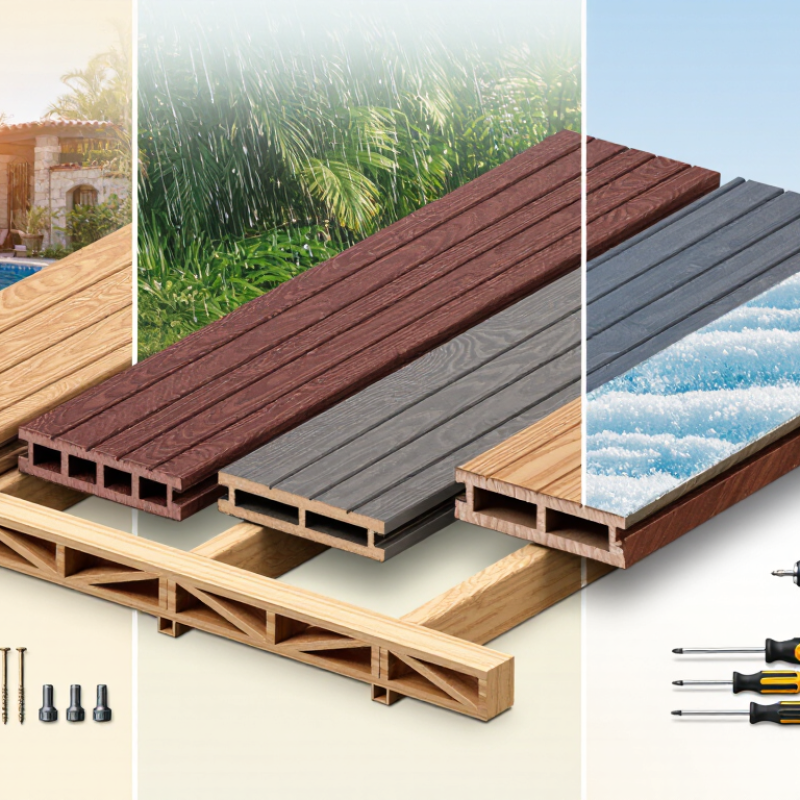
Before selecting WPC deck boards, define the project conditions clearly. Start with the site. Is it a hotel terrace, public walkway, balcony, or private garden? Each application creates different demands for loading, appearance, drainage, and maintenance. Record the expected pedestrian traffic, furniture weight, drainage slope, and available installation space.
Climate deserves careful attention. Measure seasonal temperatures, rainfall, humidity, sunlight, and freeze-thaw exposure. WPC boards expand and contract, so installers need suitable gaps at board ends and around fixed structures. Dark surfaces may become hot under strong sunlight. In wet areas, choose a surface texture that supports slip resistance without trapping excessive dirt. Local building codes should guide fire performance, structural loading, and accessibility requirements. A qualified project engineer should verify the complete deck system, not only the boards.
Substructure compatibility is equally important. Check joist spacing, ventilation, fastener requirements, and contact with standing water. For international projects, confirm container dimensions, packaging protection, customs documents, and replacement quantities before production. Small color differences can appear between batches. Plan for them. A common mistake is choosing boards from a sample without testing them outdoors. That assumption can fail. Request technical data, installation instructions, and test reports from reliable suppliers. Also clarify cleaning methods, warranty conditions, and expected service life. A realistic maintenance schedule often matters more than a perfect first impression.
| Project Requirement | Key Design Question | Practical Specification or Target | Recommended Verification | Global Project Note |
|---|---|---|---|---|
| Application and traffic level | Will the deck serve a residence, hospitality area, public walkway, rooftop, or waterfront facility? | Define pedestrian intensity, furniture loads, maintenance equipment, access frequency, and expected service life before selecting the board profile. | Prepare a project load schedule and confirm the board-and-joist system with structural calculations. | Commercial and public projects generally require more conservative span, fixing, slip, and fire requirements than private residential decks. |
| Climate and temperature range | What are the design temperatures, solar exposure, humidity, freeze-thaw cycles, and wind conditions? | Select boards tested for the project climate and allow movement at board ends and perimeter restraints. Use the supplier’s measured coefficient of thermal expansion for final detailing. | Review thermal movement data, installation temperature limits, and regional engineering requirements. | Dark colors and exposed rooftops can reach much higher surface temperatures than ambient air, increasing movement and heat gain. |
| Structural loading and joist spacing | What uniform and concentrated loads must the finished deck support? | Use a tested maximum joist spacing rather than relying only on board thickness. Reduce spacing at stairs, edges, diagonal layouts, and heavy-load zones. | Check flexural strength and deflection using applicable methods such as ASTM D7032, ASTM D6109, or the relevant local standard. | The allowable span depends on the complete system, including board geometry, temperature, support conditions, and fastener layout. |
| Moisture and water exposure | Will the deck be exposed to rainfall, standing water, pool splash, sea spray, or high humidity? | Specify low water uptake, effective drainage, ventilated substructure, capped or sealed board ends where required, and corrosion-resistant fasteners. | Review water absorption, dimensional stability, freeze-thaw, and mold-resistance test data where relevant. | WPC is moisture-resistant but is not automatically waterproof; poor drainage can damage boards, joists, and connections. |
| Slip resistance | Will users walk on the surface when it is wet, contaminated, inclined, or barefoot? | Choose a surface texture and drainage pattern suitable for wet pedestrian use; define the required wet slip classification in the project specification. | Request wet slip-resistance testing to the destination-market method, such as EN 16165 or an applicable national standard. | Slip results vary with test method, direction, footwear, contamination, and surface wear; do not compare unrelated classifications directly. |
| Fire performance | Does the project include a high-rise building, escape route, balcony, rooftop, or public assembly area? | Set the required reaction-to-fire or flame-spread classification before procurement. The board, substructure, gaps, and installation method may be assessed together. | Use the authority’s required method, such as EN 13501-1 or ASTM E84, and obtain a current test report for the specified construction. | Fire classifications are not interchangeable across regions; the local building code and end-use location control acceptance. |
| UV exposure and color stability | How much direct sunlight will the boards receive, and is color uniformity important? | Specify a UV-weathering test duration, permitted color change, and appearance acceptance criteria. Expect some initial weathering in outdoor use. | Review accelerated weathering data, such as ISO 4892-3 or ASTM G154, together with natural-weathering evidence where available. | Color changes can differ between exposed and shaded areas, especially during the first months after installation. |
| Substructure compatibility | Will the boards be installed over treated timber, aluminum, galvanized steel, or another support system? | Confirm joist width, level tolerances, ventilation, drainage, fixing method, and galvanic compatibility before finalizing the board. | Review installation drawings, fastener pull-out data, and compatibility requirements for the complete assembly. | A durable board can fail prematurely when the substructure retains water, moves excessively, or is inadequately supported. |
| Expansion joints and installation tolerances | How will the design accommodate longitudinal movement, butt joints, perimeter gaps, and fixed points? | Use the board’s tested movement data and installation-temperature chart; do not apply one universal gap value to every WPC product. | Require a project-specific laying pattern, end-gap table, ventilation detail, and tolerance schedule. | Long runs, dark boards, high solar exposure, and restricted ventilation require especially careful movement planning. |
| Surface temperature and user comfort | Will the deck be used barefoot or located around swimming pools, resorts, or playgrounds? | Consider lighter colors, ventilated installation, shade, and a surface-temperature review during design. | Compare solar absorptance or measured surface-temperature data for shortlisted colors and profiles. | No outdoor deck color should be assumed cool under intense sun; color and ventilation strongly influence heat buildup. |
| Maintenance and cleaning | What cleaning equipment, chemicals, labor, and maintenance frequency are available locally? | Define approved cleaning agents, pressure limits, stain-removal procedures, inspection intervals, and replacement-board availability. | Request care instructions and test evidence for mold, stain, abrasion, and household or commercial cleaning exposure. | Maintenance requirements should be compatible with local water quality, labor practices, and environmental restrictions. |
| Logistics and dimensional control | Can the required lengths, colors, trims, and replacement quantities be delivered to the project site? | Confirm standard board lengths, allowable dimensional tolerances, packaging, storage conditions, lead time, and spare-board percentage. | Approve a physical sample, verify batch consistency, and inspect delivered moisture, damage, color, and profile dimensions. | Store boards flat, dry, supported, and protected from direct sun before installation; follow the project’s handling instructions. |
| Environmental and compliance requirements | Does the project require recycled content, responsible sourcing, product declarations, or restricted-substance compliance? | Define required recycled-content documentation, environmental product information, chemical compliance, and end-of-life expectations. | Review declarations, chain-of-custody records where applicable, safety data, and destination-market regulatory documents. | Environmental claims should be supported by verifiable, product-specific documentation rather than generic marketing statements. |
| Warranty and service life planning | What performance period, exclusions, inspection process, and repair strategy does the project require? | Match the warranty scope to the actual use, climate, installation method, maintenance plan, and documentation available at handover. | Obtain written warranty terms, installation requirements, exclusions, batch traceability, and a replacement procedure. | A product warranty does not replace correct structural design, installation, drainage, inspection, and routine maintenance. |
Note: Target values and test methods should be finalized against the destination country’s building code, project classification, climate data, and the tested performance of the complete WPC decking system.