Leave Your Message
For global buyers, finding a dependable Laminate Wall manufacturer in China takes more than comparing catalog photos and quoted prices. Product details matter. Surface finish, panel dimensions, core material, edge treatment, and installation requirements can all affect whether a product suits a project. This guide introduces manufacturers and offers practical points for comparing their capabilities, product ranges, customization options, and communication. Company listings are starting points, not endorsements.
A website cannot show everything. Request samples and inspect their color, texture, edges, and finish under realistic lighting. Ask suppliers for clear specifications, production details, and relevant test documents where applicable. Confirm tolerances, packaging, lead times, and how quality concerns are handled before placing an order. Small differences can become noticeable across a large wall. They may matter.
The manufacturers discussed here serve different needs, so the lowest quotation may not represent the best overall value. Compare like-for-like specifications, and keep written records of agreed requirements. If answers are vague, ask again; that extra step can prevent confusion later. No supplier can be judged by a single sample or brochure alone. Buyers should verify current capabilities directly and consider independent inspection when project scale or risk justifies it. This guide is designed to support that due diligence, not replace it.
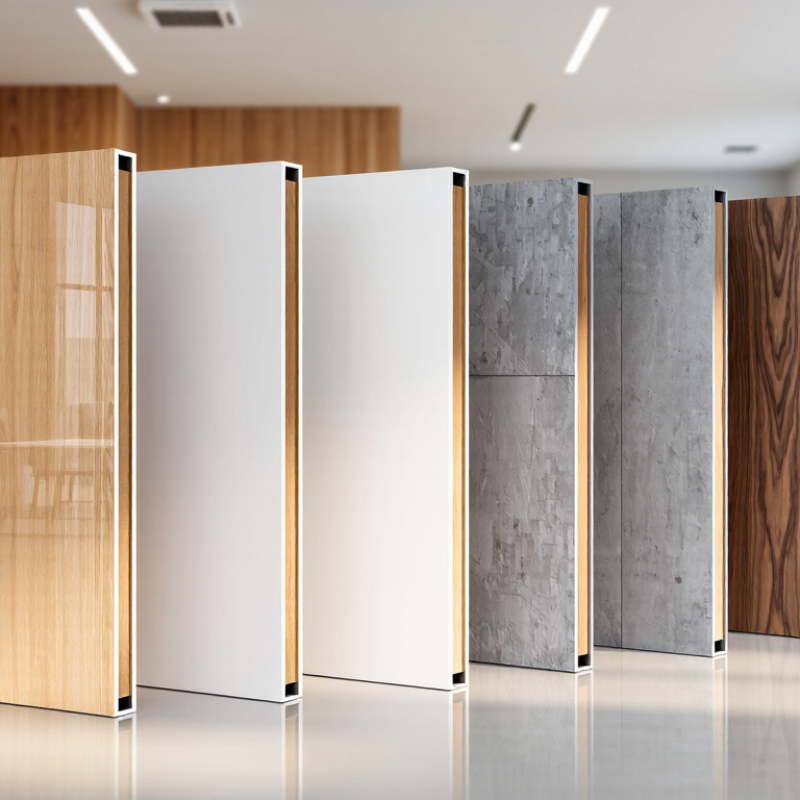
Laminate wall panels are layered products, not simply printed boards. A core of MDF, particleboard, plywood, or another panel material supports a decorative paper or film. Resin bonds the surface layer to the core. In high-pressure laminate, resin-treated papers are stacked and consolidated under heat and pressure; thinner laminates may be pressed directly onto a board. The USDA Forest Products Laboratory’s Wood Handbook explains that wood changes dimension as its moisture content shifts, making core conditioning important. Small details matter.
Manufacturing typically involves preparing and sanding the core, applying the laminate, pressing, cooling, trimming, and inspecting the finished panel. Checks can include thickness, surface defects, and bond quality. A neatly finished face does not guarantee a moisture-resistant cut edge. The FAO’s 2023 Global Forest Products Facts and Figures reports that worldwide wood-based panel production reached about 400 million cubic metres in 2022, up 1.2% from 2021. That figure describes the broader panel sector, not laminate wall panels alone. It does show why buyers should ask suppliers about core composition, resin system, and quality-control records rather than judge panels by surface appearance alone. A little skepticism is useful.
| Panel Type | Typical Construction | How It Is Made | Common Applications | Key Buyer Checks |
|---|---|---|---|---|
| HPL-faced MDF panel | Decorative high-pressure laminate (HPL) bonded to a medium-density fibreboard (MDF) core. | Decorative papers and kraft papers are impregnated with thermosetting resins, layered, and consolidated under heat and pressure to form HPL. The finished laminate is then bonded to MDF and cut to the required panel size. | Interior wall cladding in dry or controlled indoor environments, including offices, retail spaces, and residential interiors. | Check the MDF grade, panel thickness, laminate finish, bonding quality, and applicable emissions documentation. MDF-based panels should not be assumed to be waterproof. |
| HPL-faced plywood panel | HPL bonded to a plywood core made from thin wood veneers joined with adhesive. | Veneers are assembled into plywood and pressed. HPL is produced separately, then bonded to the plywood surface with a suitable adhesive and finished to the specified dimensions. | Interior wall applications where a plywood core is specified for its construction or fixing requirements. | Confirm plywood grade, veneer construction, core thickness, adhesive suitability, surface balance, and intended indoor or moisture-exposure conditions. |
| Compact HPL panel | A self-supporting laminate panel made from multiple resin-impregnated paper layers, without a separate MDF or plywood core. | Resin-treated paper layers are stacked and consolidated under heat and pressure into a dense panel. The edges may be left exposed or finished according to the design and installation requirements. | Interior wall cladding and other applications that call for a solid laminate panel; suitability depends on the product specification and installation conditions. | Check thickness, panel dimensions, fixing system, surface finish, applicable test reports, and whether the product is rated for the intended environment. |
| Melamine-faced particleboard panel | Particleboard with a decorative resin-treated paper surface, commonly described as melamine-faced board. | Wood particles are blended with adhesive and pressed into board. Decorative paper is applied to the surface using heat and pressure. This is a distinct construction from HPL-faced board. | Interior decorative applications where the specified board grade and environmental conditions are suitable. | Verify the board grade, surface specification, edge treatment, emissions documentation, and moisture limitations. Do not treat it as equivalent to HPL without checking the product construction. |
| Typical HPL manufacturing sequence | Decorative paper, kraft-paper core layers, thermosetting resins, and, where specified, a protective overlay. |
|
Used as the decorative surface in HPL-faced boards or as the material for compact laminate panels. | Request product-specific technical data and test documentation. Manufacturing details and performance depend on the product specification and applicable standards. |
| Panel finishing and quality checks | Finished panels may include cut-to-size edges, drilled fixing points, edge treatments, or protective packaging. | After lamination, panels are cut and finished to the order specification. Quality checks may cover dimensions, visual appearance, surface defects, and bonding, according to the agreed inspection plan. | Project-specific wall systems and interior fit-outs. | Agree on tolerances, inspection criteria, sample approval, packaging, labelling, and shipping protection before placing an order. Fire performance must be verified for the specified panel and, where relevant, the complete wall assembly. |